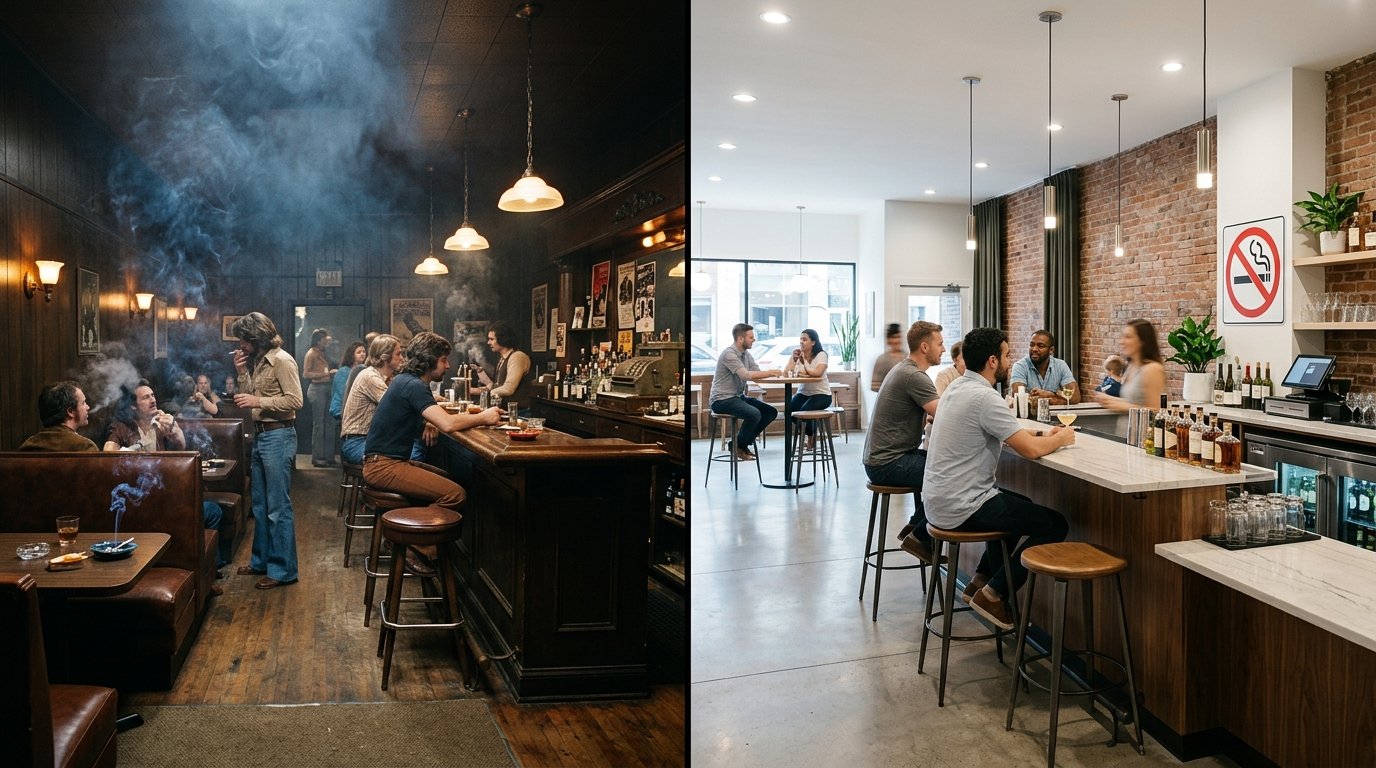
The question “when was smoking banned indoors” does not have one universal answer because indoor smoking restrictions were introduced at different times in different countries, states, and cities. Some places introduced limited restrictions decades ago, while comprehensive bans covering workplaces, restaurants, bars, and other enclosed public areas arrived much later.
One of the most important milestones came in Ireland in 2004, when the country became the first in the world to introduce a nationwide ban covering smoking in workplaces, including pubs and restaurants. Other countries followed with their own smoke-free laws. In the United Kingdom, for example, comprehensive workplace and enclosed public-place restrictions were introduced in stages between 2006 and 2007.
When Was Smoking First Restricted Indoors?
Indoor smoking restrictions existed long before modern nationwide smoking bans. Governments and local authorities gradually introduced rules as concerns about tobacco smoke and exposure to other people’s smoke increased.
In the United States, some of the earliest modern clean-indoor-air measures appeared during the 1970s. Connecticut passed a state law restricting smoking in restaurants in 1974, while Minnesota introduced a statewide law restricting smoking in public places in 1975. These measures did not create a complete nationwide indoor smoking ban, but they represented important early steps toward smoke-free public environments.
Local restrictions continued to expand during the 1980s and 1990s. For example, Aspen, Colorado, restricted smoking in restaurants in 1985, while San Luis Obispo, California, became the first U.S. city to restrict indoor smoking in bars as well as restaurants in 1990.
When Was Smoking Banned Indoors in Ireland?
Ireland provides one of the clearest answers to the question “when was smoking banned indoors?” at the national level.
On 29 March 2004, Ireland introduced a nationwide ban on smoking in workplaces. The restrictions covered public buildings, hospitals, shops, pubs, restaurants, and other workplaces. Ireland became the first country to introduce such a comprehensive national indoor smoking ban.
The legislation was based on the Public Health (Tobacco) Act 2002. The Irish Statute Book records 29 March 2004 as the commencement date for several provisions associated with the smoking restrictions.
The Irish experience became an important reference point for other countries considering similar legislation. According to Ireland’s Health Service Executive, 74 countries had subsequently followed Ireland’s example with complete smoking bans in indoor public places, workplaces, and public transport as of 2024.
When Was Smoking Banned Indoors in the United Kingdom?
The United Kingdom introduced indoor smoking restrictions in stages rather than through one single nationwide date.
Scotland introduced its ban on smoking in enclosed public spaces and workplaces on 26 March 2006. Wales followed on 2 April 2007, and Northern Ireland introduced its restrictions on 30 April 2007. England followed on 1 July 2007.
In England, the regulations came into force at 6 a.m. on 1 July 2007. They covered almost all enclosed and substantially enclosed public places and workplaces, as well as public transport and most work vehicles.
This means that if someone asks specifically when smoking was banned indoors in England, the key date is 1 July 2007.
The UK timeline demonstrates why it is important to specify a country when discussing indoor smoking bans. Although people often refer to a “UK smoking ban,” the individual nations implemented their legislation on different dates.
When Was Smoking Banned Indoors in the United States?
There was never one nationwide U.S. date when smoking was banned indoors across every state and public venue.
Instead, smoking restrictions developed through a combination of federal policies, state laws, and local ordinances. The federal government did not enact a comprehensive nationwide workplace and public-place smoking ban. State and local governments therefore played a major role.
Minnesota’s 1975 statewide law was an early milestone. Utah later became the first state to enact a comprehensive statewide ban on smoking in public places, passing its Indoor Clean Air Act in 1994. California also introduced a statewide smoking ban for restaurants that took effect in 1995.
By the 2000s, many more U.S. states and cities had adopted comprehensive smoke-free laws. Minnesota eventually expanded its restrictions, with a statewide ban covering restaurants and bars taking effect in 2007.
Therefore, the correct answer for the United States depends on whether the question refers to a particular state, city, workplace, restaurant, or another type of indoor location.
Why Did Indoor Smoking Bans Become Common?
The development of indoor smoking restrictions was closely connected to growing evidence about exposure to secondhand smoke.
Earlier smoking rules often focused on comfort, fire safety, or separating smokers from nonsmokers. Over time, public-health research increasingly emphasized the health consequences of involuntary exposure to tobacco smoke.
A major milestone came in 1986, when the U.S. Surgeon General issued a report focused specifically on the health consequences of involuntary smoking. The report identified secondhand smoke as a cause of lung cancer in healthy nonsmokers.
This growing scientific evidence helped shift the discussion from whether smoke was merely unpleasant to whether governments should protect people from involuntary exposure in workplaces and public areas.
How Did Smoking Bans Affect Restaurants and Bars?
Restaurants, pubs, and bars became particularly important in the development of smoke-free laws because these businesses were traditionally associated with indoor smoking.
Before comprehensive bans, restaurants frequently had designated smoking and nonsmoking sections. However, separating customers within the same indoor environment did not necessarily eliminate exposure to tobacco smoke.
Modern smoke-free laws increasingly moved toward prohibiting smoking throughout enclosed venues rather than simply separating smoking areas.
Ireland’s 2004 legislation was especially significant because it included pubs and restaurants. The change demonstrated that a national government could apply a broad indoor smoking restriction across the hospitality sector.
What Does “Smoke-Free” Mean Today?
The exact meaning of a smoke-free law depends on the legislation in a particular jurisdiction.
The World Health Organization distinguishes between different levels of protection. A complete smoking ban, for example, means smoking is not permitted in an indoor area under any circumstances, including private functions or separate smoking rooms. Some jurisdictions have instead allowed designated smoking rooms or other limited exceptions.
This distinction matters when comparing countries. Two places may both describe themselves as having indoor smoking restrictions while applying different rules to hotels, prisons, workplaces, restaurants, bars, or other facilities.
When Was Smoking Banned Indoors in Pakistan?
Pakistan introduced national legislation addressing smoking in public places before many of the major European smoke-free laws.
Under the Prohibition of Smoking and Protection of Non-Smokers Health Ordinance, 2002, tobacco use at places of public work or public use was prohibited. Pakistan later introduced additional measures, including regulations under which designated smoking areas were declared illegal and places of public work or use were declared completely smoke-free.
This makes Pakistan another example of why the phrase “when was smoking banned indoors” needs to be interpreted according to the country and the specific legislation involved.
A Simple Timeline of Indoor Smoking Bans
The development of indoor smoking restrictions can be summarized through several major milestones:
| Year | Location | Important development |
|---|---|---|
| 1974 | Connecticut, USA | State law restricted smoking in restaurants |
| 1975 | Minnesota, USA | Statewide restrictions on smoking in public places |
| 1985 | Aspen, Colorado | Restaurant smoking restrictions introduced |
| 1990 | San Luis Obispo, California | Indoor smoking restrictions extended to bars and restaurants |
| 1994 | Utah, USA | Comprehensive statewide public-place smoking ban |
| 1995 | California, USA | Statewide restaurant smoking ban took effect |
| 2002 | Pakistan | National ordinance addressed smoking in public places |
| 2004 | Ireland | Nationwide workplace smoking ban introduced |
| 2006 | Scotland | Indoor workplace and public-space ban introduced |
| 2007 | Wales | Indoor smoking restrictions introduced |
| 2007 | Northern Ireland | Indoor smoking restrictions introduced |
| 2007 | England | Smoke-free regulations took effect on 1 July |
These dates illustrate that indoor smoking restrictions developed gradually rather than arriving worldwide on a single date.
Frequently Asked Questions
When was smoking banned indoors worldwide?
There is no single worldwide date. Countries introduced indoor smoking restrictions at different times. Ireland’s 29 March 2004 law is one of the most important milestones because it created the world’s first nationwide comprehensive ban covering workplaces such as pubs and restaurants.
When was smoking banned indoors in England?
Smoking in enclosed workplaces and most enclosed public places in England was prohibited from 1 July 2007. The regulations also covered public transport and most work vehicles.
When did Ireland ban smoking indoors?
Ireland’s nationwide indoor workplace smoking ban began on 29 March 2004. It covered places including pubs, restaurants, public buildings, hospitals, and shops.
Was there a nationwide indoor smoking ban in the United States?
No single nationwide ban covers all indoor public places in the United States. Restrictions developed through state and local laws, with some jurisdictions adopting comprehensive bans earlier than others.
Conclusion
So, when was smoking banned indoors? The answer depends on where you mean. Indoor smoking restrictions began appearing in some places during the 1970s, but comprehensive national bans came later. Ireland’s nationwide ban on 29 March 2004 was a landmark event, followed by major smoke-free laws across the UK between 2006 and 2007.
In the United States, there was no single nationwide date; instead, states and cities introduced restrictions over several decades. Pakistan introduced national restrictions through its 2002 tobacco-control ordinance and subsequent regulations.
The overall history shows a gradual transition from designated smoking areas and limited restrictions toward broader smoke-free indoor environments. The exact rules, exceptions, and enforcement measures still depend on the jurisdiction and type of premises involved.