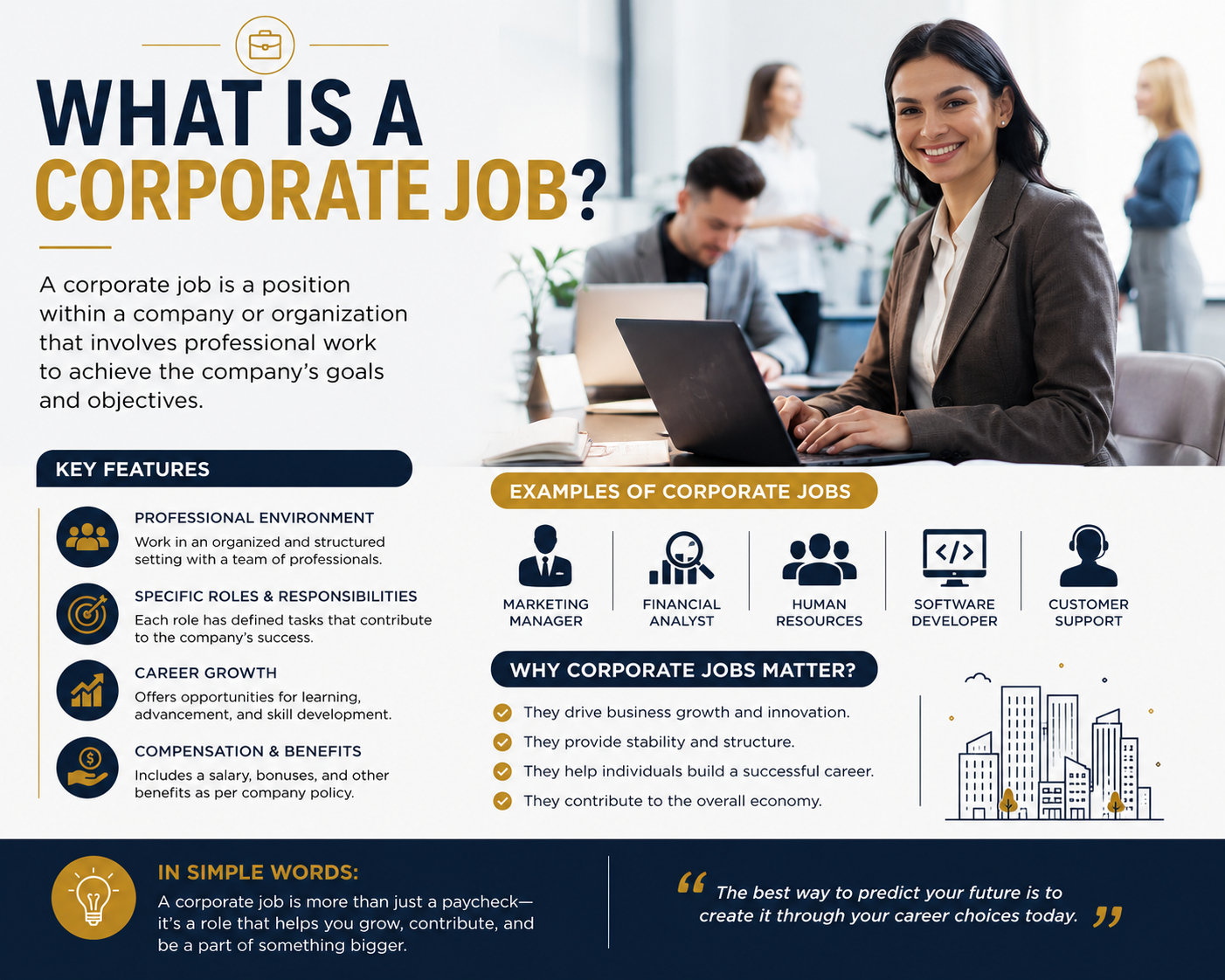
Understanding what is a corporate job
A corporate job refers to employment within a large, structured organization where work is divided into departments such as finance, marketing, human resources, operations, and information technology. When people search for what is a corporate job, they are usually trying to understand how office-based professional careers function inside big companies that operate with formal rules, systems, and clear reporting structures. In a corporate environment, employees do not work independently like freelancers or small business owners; instead, they contribute to a larger organizational goal by performing specific tasks assigned to their role. These jobs often exist in banks, multinational companies, IT firms, consulting agencies, and manufacturing corporations, where teamwork and coordination are essential for success.
Meaning and Definition of a Corporate Job
A corporate job is formally defined as a position of employment within a corporation or a large-scale business organization that operates through a structured system of departments, policies, and management levels. When explaining what is a corporate job, it is important to understand that these roles are designed to support the overall functioning of a company rather than focusing on individual or informal work. Employees are assigned specific responsibilities based on their expertise, such as handling financial reports, managing client communication, developing software, or overseeing human resource activities, all of which contribute to the organization’s long-term objectives and profitability.
In practical terms, a corporate job represents a professional career path where individuals work within a hierarchy that includes entry-level employees, mid-level managers, and top executives. Each level has distinct duties, decision-making power, and performance expectations. Unlike small businesses or freelance work, corporate employment emphasizes consistency, accountability, and collaboration across multiple teams. This structure ensures that large organizations can operate efficiently at scale while maintaining quality, productivity, and growth across different departments and markets.
Types of Corporate Jobs and Industries
Corporate jobs exist across a wide range of industries, offering diverse career opportunities depending on skills, education, and interests. When exploring what is a corporate job, it is important to understand that these roles are not limited to one field; instead, they are found in sectors such as banking, information technology, healthcare, finance, retail, manufacturing, and consulting. For example, in the IT industry, corporate roles may include software developers, system analysts, and cybersecurity experts, while in the banking sector, professionals may work as financial analysts, loan officers, or investment advisors. Each industry has its own specialized corporate positions, but all follow a structured environment where employees work toward organizational goals through defined responsibilities and teamwork.
Corporate Job Structure and Hierarchy
Corporate jobs follow a well-defined structure and hierarchy that ensures smooth workflow and clear reporting lines within an organization. In understanding what is a corporate job, it is essential to recognize that most companies are organized into different levels, starting from entry-level employees who handle day-to-day tasks, moving up to mid-level managers who supervise teams, and finally reaching senior executives who make strategic decisions for the company. This hierarchical system helps maintain discipline, accountability, and efficiency, as every employee knows their role, responsibilities, and who they report to, which reduces confusion and improves productivity across departments.
Within this structure, communication flows both upward and downward, meaning employees receive instructions from managers while also providing feedback and progress reports. Large corporations often divide work into departments such as marketing, finance, HR, and operations, each led by department heads who coordinate with upper management. This organized system not only supports better decision-making but also creates clear career progression paths for employees, allowing them to grow from junior positions to leadership roles over time through performance, experience, and skill development.
Skills Required for Corporate Jobs
To succeed in a corporate environment, professionals need a combination of technical knowledge and soft skills that help them perform effectively in structured workplaces. When understanding what is a corporate job, it becomes clear that these roles require strong communication skills, problem-solving ability, teamwork, and time management, as employees often collaborate with different departments and must meet deadlines consistently. In addition to soft skills, most corporate positions also demand role-specific technical skills, such as financial analysis for accountants, coding for IT professionals, or marketing strategy development for digital marketers, making continuous learning an important part of career growth.
Apart from professional expertise, adaptability and emotional intelligence also play a major role in corporate success. Employees must be able to handle pressure, respond to changing business needs, and maintain professional relationships with colleagues and clients. Many companies also value leadership potential, even in entry-level employees, because corporate environments are designed for long-term career development. As industries become more competitive and technology-driven, individuals who regularly upgrade their skills and stay updated with industry trends have a stronger chance of growing within the corporate structure.
Salary and Career Growth in Corporate Jobs
Salary in corporate jobs varies widely depending on factors such as industry, job role, experience level, and company size, but one of the main attractions of understanding what is a corporate job is the potential for stable income and long-term financial growth. Entry-level positions may start with modest salaries, especially for fresh graduates, but as employees gain experience and develop specialized skills, their earning potential increases significantly. Large multinational companies often offer competitive salary packages along with bonuses, performance incentives, health benefits, and retirement plans, making corporate careers financially rewarding over time.
Career growth in corporate jobs is usually structured and performance-based, meaning employees can move up the ladder from junior roles to senior management positions through consistent performance, skill development, and leadership ability. Promotions are typically linked to annual evaluations, project success, and contribution to company goals. Many corporations also invest in employee training programs, certifications, and internal promotions to encourage long-term retention and professional development. This creates a clear pathway for career advancement, allowing motivated individuals to build a stable and progressive professional future within the corporate system.
Advantages and Disadvantages of Corporate Jobs
Corporate jobs offer several advantages that make them attractive to job seekers, especially those exploring what is a corporate job and how it fits into long-term career planning. One of the biggest benefits is job stability, as large companies often provide consistent salaries, structured work environments, and employee benefits such as health insurance, paid leave, and retirement plans. Additionally, corporate roles offer clear career growth opportunities, exposure to professional training, and the chance to work with experienced teams, which helps individuals develop both technical and soft skills over time in a highly organized setting.
However, corporate jobs also come with certain disadvantages that should be considered. Many employees experience high work pressure due to strict deadlines, performance targets, and long working hours, especially in competitive industries like finance and IT. The structured hierarchy can sometimes limit creativity or slow down decision-making, as approvals often need to pass through multiple levels of management. Despite these challenges, many professionals still prefer corporate careers because the benefits, financial stability, and growth opportunities often outweigh the drawbacks in the long run.
How to Get a Corporate Job (Career Path)
Getting a corporate job requires a combination of education, skill development, and strategic career planning, especially for those trying to understand what is a corporate job and how to enter this professional world. Most candidates begin by completing a relevant degree in fields such as business, finance, computer science, marketing, or human resources, depending on their desired industry. After education, gaining practical experience through internships, part-time roles, or entry-level positions is highly important, as corporations value real-world exposure alongside academic qualifications.
In addition to education and experience, building a strong resume and professional presence plays a key role in securing corporate employment. Candidates should focus on developing in-demand skills such as communication, teamwork, and technical expertise, while also preparing for interviews that often include behavioral and situational questions. Networking through professional platforms, job fairs, and industry connections can further improve chances of getting hired. Once hired, continuous learning and performance consistency are essential for long-term success and career advancement within the corporate system.
Conclusion & FAQs
In conclusion, understanding what is a corporate job helps clarify how modern professional careers are structured within large organizations that rely on departments, hierarchy, and teamwork to achieve business goals. Corporate jobs offer stable income, clear career progression, and opportunities for skill development across various industries such as IT, finance, marketing, and management. While these roles can sometimes involve pressure, deadlines, and structured workflows, they remain one of the most popular career choices due to their long-term growth potential and financial security.
FAQs
1. What is a corporate job in simple words?
A corporate job is a professional office job in a large company where employees work in structured roles and departments.
2. Is a corporate job good for career growth?
Yes, corporate jobs offer clear promotion paths and skill development opportunities over time.
3. What qualifications are needed for a corporate job?
Most corporate jobs require a relevant degree plus communication, technical, and teamwork skills.
4. Do corporate jobs pay well?
Yes, salaries can start moderate but increase significantly with experience and senior positions.